Nancy Edna Mills — Raising a Family in New Brunswick

William LEONARD Jukes and Nancy Edna Mills

Leonard met Nancy Mills of Douglas , at an Anglican church picnic in Douglas in 1908 and married her on April 4, 1915 following the death of Nancy’s mother, Nancy Francina (Hanson) Mills. Shortly after their marriage they moved to Plaster Rock, NB where Leonard worked for the Fraser Mills on log drives, cutting trees and in the lumber mill. Three children, Mary, Clifford and Alfred were born in Plaster Rock. By 1927, when my mother Frances MARGARET Adeline Jukes was born the family was living in Edmondston, NB. Leonard was now working for the Fraser Farms, tending cows and delivering milk by horse and cart to families in the areas. Two other children were born in Edmonston, Leonard Jr and Horace before the family left Edmondston and moved to Fredericton Junction, Sunbury County where Leonard found work, running a farm by 1935. Later the family moved to Three Tree Creek where Leonard rented a house and land and made a living for the family by cutting and selling pulp. During the war years Leonard was able to purchase a small house and farm on the Tracy highway where he continued to cut pulp using horses to pull the logs out of the woods. The children including their daughter Margaret worked in the woods peeling pulp. At the end of the war none of Leonard’s sons were interested in working on the farm in Tracy so he sold the farm and purchased a lot of land Nashwaaksis and built a small house at 227 Sunset Drive in 1947.  This is where I grew up. Leonard continued as a night watchman in a nearby mill and later on the John Wilkins Farm. He also worked as a flagger during the construction of the first Oromocto by-pass in the mid-fifties

Leonard was a great fan of horse racing and spent many happy hours in the horse barns and watching the races at the Fredericton Raceway. As a child I remember the smell of his old red plaid jacket when he returned from the horse barn and knew that those pockets contained pink peppermints for the horses which he occasionally offered to us if we begged and pulled on his pocket. He looked forward the Fredericton Exhibition each year and annually donated a case of canned milk to the Anglican Church Canteen each year.

While Leonard was busy making a living for his family, Nancy worked hard at home. She was an avid reader of the Family Herald and a member of the Doubleday Book club. She was extremely resourceful, making her own dresses by creating paper patterns. She made quilts from old coats and other scraps of materials. I remember her crazy quilts which were quilted together using bright red knots of yarn scattered everywhere. She made wonderful seasonal preserves including crab apple, chokecherry, strawberry, blueberry jams and jelly. She crocheted beautiful doilies and knitted plenty of socks and mittens over the years for the family. She kept many scrapbooks of poems, obituaries and recipes over the years.  Before she died in 1960 she taught me how to knit.

Our family was still traveling to Three Tree Creek in the late 1950s to pick blueberries and high bush cranberries and I have many happy memories as a child of these trips as well as sugar cookies, Johnny cake, bread and baked beans made by both my mother and my grandmother.

My grandmother was one of those women who had no money of her own, save for whatever my grandfather chose to give her for groceries from time to time. He controlled the purse strings. Imagine her sense of freedom when she began receiving the old-age pension in 1956. She began taking the bus to Saint John to visit her daughter, Mary, and began visiting and spending time with her grandchildren in Fredericton and Saint John. I remember the red plaid scarf hats that she purchased for me and my sister Grace in the fall of 1957. Her life definitely changed during that time. Unfortunately she died of a massive coronary while visiting her daughter Mary, in 1960.

After my grandmothers death, my grandfather moved between his children’s homes until his death in 1973. It was as if he was never content in one place after Nancy died.

(Footnote) Brennan, Grace. Interview of Margaret Jukes Brennan for Gerontology 201, STU)

Kenneth Alfred Jukes, North Shore Regiment and the Battle of Normandy

Kenneth Alfred Jukes,  North Shore Regiment, killed in France on August 8, 1944.

poppy

My mother Frances MARGARET Adeline Jukes told me about a warm summer day in August 1944 in Traceyville, NB. She was working in the garden of their next door neighbour. Her parents Leonard and Nancy Jukes had gone to Fredericton by  horse and wagon and would be gone all day. The neighbour emerged from her house and walked out back towards the garden, a piece of paper in her hand. Because Leonard and Nancy were away, a message had been delivered to the next door neighbour. The neighbour told Margaret (Maggie) that there was news of her brother and that he had been killed in action on 8 August, 1944.

Kenneth ALFRED Jukes  North shore Regiment

Kenneth ALFRED Jukes
North shore Regiment

I cannot imagine my mother’s anguish and pain at this time. The neighbour insisted that Maggie keep this to herself and not tell anyone until her parents arrived home. She also insisted that she not tell her parents immediately upon their arrival home from Fredericton but to wait until after they ate their evening meal.

She explained that once they get this news they will not be able to eat for days.

So Maggie took her advice and during the meal her mother asked her a number of times, if there was something wrong as she sensed that something was bothering Maggie. Each time Maggie answered “No”. Then,  after supper she told her parents the terrible news. I imagine that it was a relief to Maggie to be able to share her grief with her parents, however what a terrible burden for a young girl to bear the responsibility of informing her parents of the loss of their son, not yet 20 years old. That night must have been one of the cruelest nights my grandparents and my mother experienced. My mother told me that she was thankful for the neighbour’s advice as her mother did not eat again for more than a week she was so overtaken with grief.

Maggie Jukes and Jim Brennan about 1947

Maggie Jukes and Jim Brennan about 1947

After the War my mother met my father James Arthur Douglas Brennan, son of Clara (Stockley) and Will Brennan in Saint John.  (This is a story for another post) . As she was telling Jim about  her bother’s death in France she mentioned the date and the area where he died. My father realized that this was during the Invasion of Normandy and he knew what happened that day because he was there too. Both men were with the 3rd Canadian Infantry Division , Alfred with the North Shore Regiment and my father,  a Gunner with the  Royal Canadian Horse Artillary.

Here is how my father explained it to me years later:
American Bombers who were providing air support dropped their markers short of the target and as a result bombed the 3rd Division Canadian Infantry which included members of the North Shore Regiment. I sat and watched  on the other side of the ridge from Alfred’s position when it was hit by “Friendly Fire”.

The War Record at the Juno Beach Centre described the same event this way:

On August 7th, armoured vehicles and tanks were positioned near the Verrières Ridge. At 2300 hours, heavy bombers were pounding the German defences and Canadians felt their enthusiasm growing as they heard the engines roar and the bombs explode. At 2330 II Corps’ columns started off on both sides of the Caen-Falaise road. Darkness and clouds of dust made progression increasingly difficult and several units lost their way. In spite of the heavy bombing, German artillery and tanks were able to put up a grim resistance. In spite of the confusion, II Corps reached its first objectives and was in position to proceed with phase two.
On August 8th, Lieutenant General, Guy Simonds who was in charge of the II Canadian Corp which included the 3rd Canadian Infantry Division, requested the US Air Force to provide aerial bombing support. At 1300, 678 aircraft flew over German positions. The German Flak countered with accurate fire and several aircraft were hit. The leader of a 12-bomber squadron being heavily damaged dropped his bomb load before reaching its target and the other aircraft, reacting automatically did the same. The bombs fell far behind the combat line but in an area that was filled with Allied troops waiting to move up to the front. Some 65 men were killed and 250 wounded from the 3rd Canadian Infantry Division and from the 1st Polish Armoured Division, not to mention equipment losses.

When my father told me this story I could not help but think back to that day in August 1944 when a young seventeen year old girl must have felt that France was such a far away place in which to lose her brother. Little did she know that the man she would meet and marry was also there in that same valley where her brother made the ultimate sacrifice.

Kenneth Alfred Jukes born 19 November 1924  is buried at Beny-Sur Mer Canadian War Cemetary where the Canadian men who gave their lives in the  landings at Normandy are buried.

Clifford Henry Wimbush Jukes, Killed In Action, Battle of Canal Du Nord, 29 September, 1918

During attack on Cambrai in the morning of September 29, 1918 he was killed by machine gun fire.

poppyThis is the single line of the official explanation of how Clifford Henry Wimbush Jukes, at 23, lost his life while fighting in France during the last days of the Great War.

From the War Diary of the 42nd Battalion we learn the details of what happened on the road to Cambrai the morning of Clifford’s death. In the early morning of September 29, 1918, Clifford was one of the 42nd Battalion, Royal Highlanders of Canada who jumped off at the Cambrai-Duai railway line leading to Cambrai and proceeded toward the road to Cambrai until they ran into a low broad line of wire running in front of a dump. It was not cut and the men were compelled to work their way through it seriously slowing their advance to the road. Some causalities occurred while cutting through the wire, however, it was at a point halfway between the wire and the road that they were met with intense german machine-gun fire from both sides at point-blank range. Clifford lost his life at some point between the cutting of the wire and approaching the road to Cambrai.

Clifford H W Jukes and Elizabeth Briggs 1917

Clifford H W Jukes and Elizabeth Briggs 1917

Clifford died 43 days short of the Armistice and the end of the War. He was buried in the Mill Switch British Cemetary located at CambrTilloy-les-Cambrai, a village 2.5 kilometres north of Cambrai. Tilloy village was captured by the Canadian Corps at the end of September 1918, and the cemetery was made by the Corps Burial Officer in the following month. The name is due to a switch line from the Cambrai-Douai railway which ran in September 1918, to a large German supply dump on the site of the mill 800 metres North-West of the cemetery. There are now over 100, 1914-18 war casualties commemorated on this site.

Clifford Henry Wimbush Jukes was born on 8 April 1894 in Birmingham, England. He came to Canada shortly after his eighth birthday with his brother William LEONARD Jukes who was eleven years old at the time. (Leonard’s story can be found in an earlier post).
The two boys arrived at the port of Halifax on June 4, 1902, under the auspices of the Middlemore Homes.

James and Isabella Davidson of Stanley opened their home to the two boys. In the 1910 Census of Canada, the Davidson’s listed Clifford as their adopted son. Clifford and Leonard worked on the Davidson farm as this was one of the primary reasons that Canadian families took Middlemore children into their care. Clifford resided with Leonard and his wife Nancy in Douglas at the time of his marriage to Elizabeth (Lizzie) Briggs on 4 March 1917. When Clifford married Lizzie he had already signed up to go to war. His Attestation Papers indicate his occupation was cook, while his marriage certificate states his occupation as a soldier. Before he married Lizzie he lived with his brother Leonard and his family in Douglas, NB.  Clifford’s daughter Doris Eliza Jukes was born 5 March 1918 in Fredericton and was just 5 months old at the time of his death.

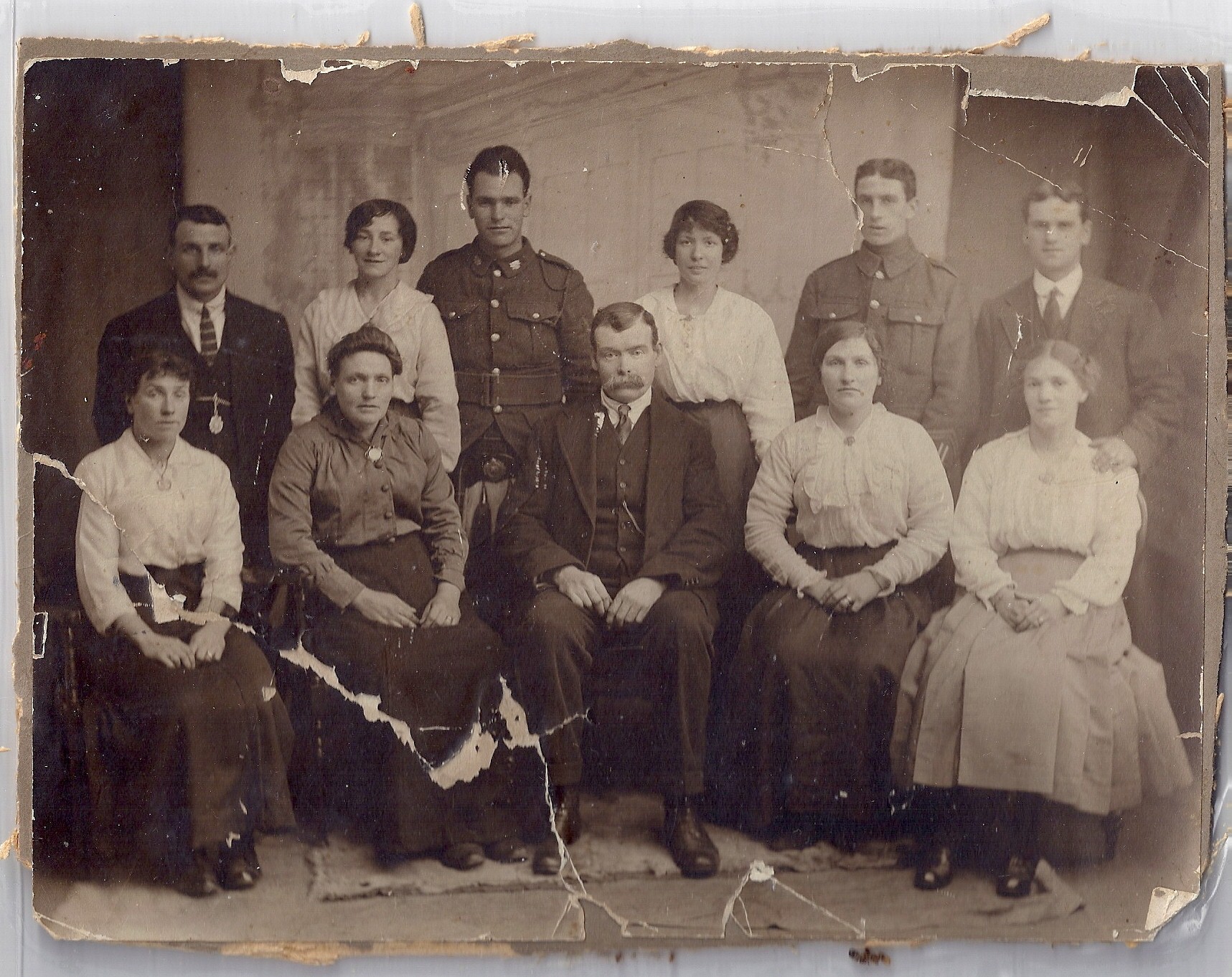
It has been suggested by some researchers that many British Home Children signed up to serve in the Canadian Expeditionary Force as a way to return to their families in England. Clifford listed his mother and her address, who had remarried, as his next of kin in his Attestation Papers so we know he was in contact with her. We also know that he spent time with his family in England when he went overseas because he is pictured with his family in

Jukes Family - 1918 England Clifford is in back row  between his two sisters.

Jukes Family – 1918 England
Clifford is in back row between his two sisters.his Royal Highlander Uniform in this photo. I cannot help but think that perhaps all Clifford wanted was to see his mother again.

Primary Sources
War Diary of 42nd Battalion Quebec Regiment (Royal Highlanders of Canada), Historical Documents, Archives of Canada
Middleton Homes Records, Historical Documents, Archives of Canada

Secondary Sources
Provincial Archives of New Brunswick
Canadian War Graves Commission

we-will-remember-them

Leonard Jukes, British Home Child

William Leonard Jukes, British home Child

“It isn’t a keep it’s a linger.”  Those are the words that Annie Jukes spoke on August 28, 1901, to sum up her decision to part with two of her children William Leonard Jukes, 10 and Clifford Henry age 7.

  In describing her family’s plight Annie Jukes explained “I just can not keep them in food and clothes or I would not part with them.”  Annie’s remarks are recorded along with other family information in Case No. 2236 of the Middlemore Homes.[1]   Annie’s husband, William Jukes had died five years before and with 5 children to support, the boys were forced into running errands for neighbours for food.

Annie’s request was granted on May 24, 1902, when both Leonard and Clifford departed from Liverpool on the SS Siberian.  They arrived in Halifax in June of that year.   Leonard soon found himself in Stanley, New Brunswick where he lived along with his brother Clifford, with the Davidson Family and worked on their Farm.

By 1907, at the age of 16, Leonard met Nancy Edna Mills, who lived at Claremont, which is part of present-day Douglas.  Nancy was the daughter of William Alfred Mills and Nancy Francis Hanson.  The two courted for 7 years with Leonard making trips by horse and wagon between Stanley and Claremont on Sundays, his day off. Nancy would not marry because her mother was ill and she took care of her.

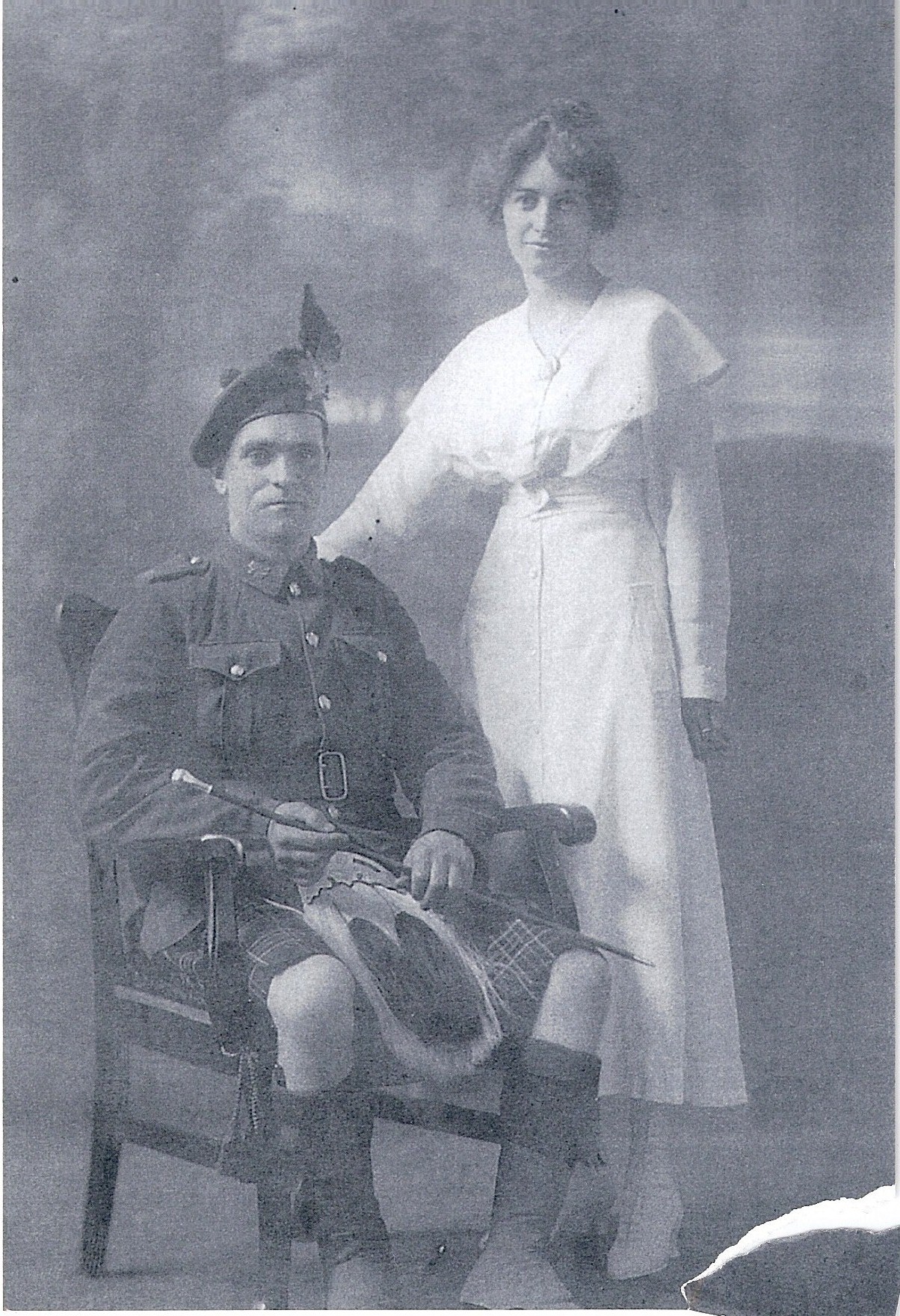
Leonard Jukes and wife Nancy Mills

Leonard Jukes and his wife Nancy Mills

Leonard and Nancy were married on April 14, 1914. By 1917 the family lived in Plaster Rock where Leonard worked for Fraser Mill.  By 1927 Leonard was working for the Fraser Dairy in Edmundston, delivering milk by horse and cart.

The family eventually settled in Traceyville in the 1930s where they farmed, logged, and traded horses until 1947, when the family moved to Nashwaaksis where Leonard worked on the John Wilkins Farm for a time.  Leonard worked hard all of his life; his last job was at the York Municipal Home when he was in his seventies.  An avid horseman he spent many a day at the Fredericton Race Track at the barns or placing the odd wager on a horse.

Our memories of our grandfather are a mix of sounds and smells.   He always carried peppermints for the horses and when he came home from the barn we would beg him for a peppermint.  I can still remember his laugh and the smell of the barn mingled with the strong taste of the peppermints.  I remember his voice when he would sing some old English hymn and when he would try to teach us how to count to 10 in Welsh, which we never mastered.  Grampy died on May 20, 1973, at the age of 82.  He left behind, 6 children, 21 grandchildren, and many great children, quite a legacy for an 11-year-old boy who found himself alone in a country he didn’t know.  More details about their life in New Brunswick can be found in the post: Nancy Mills: Raising a Family in New Brunswick.


[1] The National Archives reel A-2105 volume 246, and case number 2236. Application books #2 1895-1903.