(Who is John Vose?)
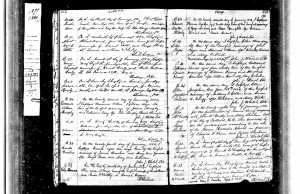
For a year I have been trying to get a separation allowance for my wife having forwarded Marriage Certificate and Birth Certificate to Ottawa. It is not that I want the money. But would like our marriage accepted by the military authorities. [i]
Daughters of the Empire insignia
Will Brennan’s application for an allowance for his young wife, Clara Stockley b. 1899 was written 95 years ago at the time of this post and gives an interesting insight into attitudes towards the military and towards asking for financial help from the military. Perhaps the request was written to make an impression on the authorities, perhaps and most likely it was Will’s pride, or perhaps this is just what one had to say to get their application for an allowance considered. In any event, the record exists.
Clara Stockley was just 18 years old at the time of her marriage to Will Brennan. Clara was the youngest daughter of Mary Eastwood and Moses Stockley II whom you met in the previous post. She had been in Canada for five years arriving in Saint John in 1912 with her parents Moses Stockley II and Mary Eastwood. The family worked in the cotton industry in Manchester, England for many years and immigrated to Saint John to take up the same work in there.
Clara’s mother, Mary (Eastwood) Stockley died in 1915 of the Spanish Influenza, and after WWI ended, her sisters Mary and Grace returned with their soldier husbands to England. Only Clara and her brother Moses Stockley III remained in Saint John.
At the age of 32 years, Will married Miss Clara Winifred Stockley, February 16, 1917 in St. Luke’s Anglican Church. John F. Petrie and Margaret Mary Hall stood up with them for the nuptials. They resided at 228 Brussels St. Saint John and by 1919 were residing at 250 City Rd., Saint John.[ii] Later they lived with Aunt Susie (Proud) and Frank Murphy on Sandy Point Rd. Saint John, NB.
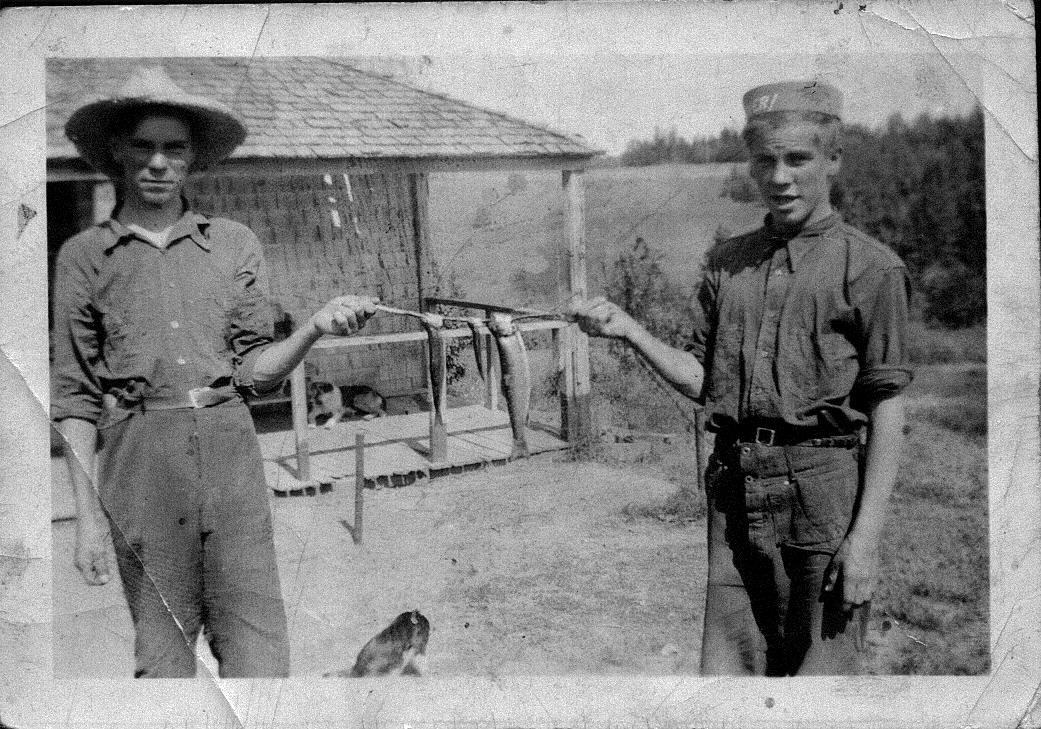
Unable to work in his electrical trade due to his War disability, Will found work as a caretaker for the Bank of Canada while the family lived in an apartment below the bank. In 1940 Will bought a farm, although he had never farmed his whole life he moved the family to Midland, Kings County, just outside of Norton, New Brunswick. In this photo, Clara’s sons James and William are showing off their catch at the farm in Norton.
Will died in Norton on February 26,1943 from heart failure and complications of pneumonia. Following his death, Clara sold the farm and moved back to Saint John. By this time her daughter Evelyn was married to Gerard (Red) Flemming and James (Jimmy, my father) was serving overseas with the remaining children living with her until their marriages on Saint David Street and then at 233 Main St. In Saint John.
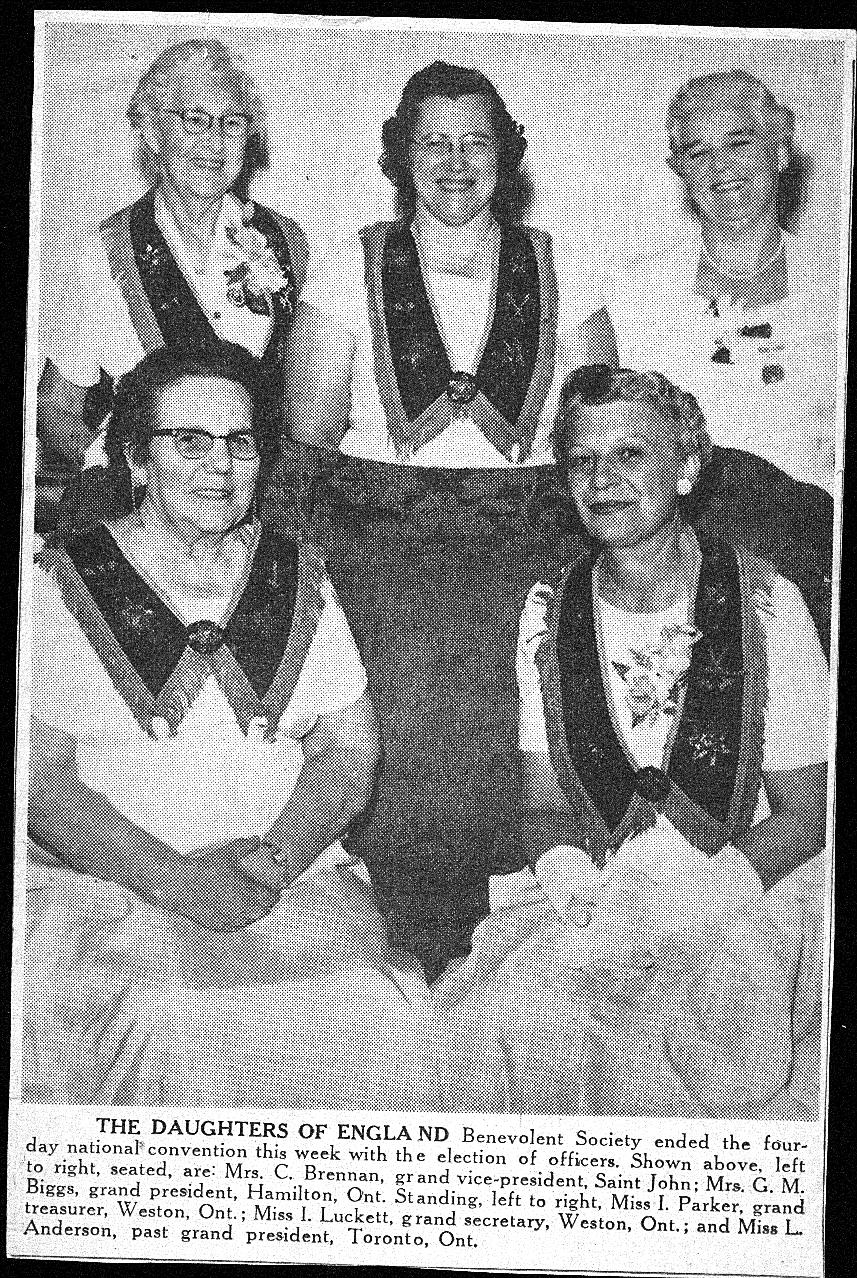 Clara maintained her close ties with England and with her family in Manchester over the years. In this picture, taken in the late 1960’s, she is pictured on the left in the front row, when she was elected Vice President of the Daughters of the Empire.
During WW II her son James, a Gunnar in Third Canadian Regiment, spent time with the Madden Family in England and kept up connections with Cecilia Madden throughout his life. Similarly, Clara’s sister Mary Dixon’s sons spent time with her in Saint John. This was because the Dixon’s served in the Navy and spent time in port in Saint John during the war.
Will and Clara had 10 children:
Josephine Evelyn (1918-1991)
James Arthur Douglas (1920-1990)
William Stanley Edward (1922-1962)
Lydia Clara May (1925-2021)
Constance Lillian (1926-2010)
Mary Margret Elizabeth (1927-1992)
Clara Winnefred (1931 – 2018)
Robert Francis Tucker (1933-2005)
Grace Louise (1934-
Lawrence Windsor (1937-1994)
Kenneth Alfred Jukes, North Shore Regiment, killed in France on August 8, 1944.

My mother Frances MARGARET Adeline Jukes told me about a warm summer day in August 1944 in Traceyville, NB. She was working in the garden of their next door neighbour. Her parents Leonard and Nancy Jukes had gone to Fredericton by horse and wagon and would be gone all day. The neighbour emerged from her house and walked out back towards the garden, a piece of paper in her hand. Because Leonard and Nancy were away, a message had been delivered to the next door neighbour. The neighbour told Margaret (Maggie) that there was news of her brother and that he had been killed in action on 8 August, 1944.

Kenneth ALFRED Jukes
North shore Regiment
I cannot imagine my mother’s anguish and pain at this time. The neighbour insisted that Maggie keep this to herself and not tell anyone until her parents arrived home. She also insisted that she not tell her parents immediately upon their arrival home from Fredericton but to wait until after they ate their evening meal.
She explained that once they get this news they will not be able to eat for days.
So Maggie took her advice and during the meal her mother asked her a number of times, if there was something wrong as she sensed that something was bothering Maggie. Each time Maggie answered “No”. Then, after supper she told her parents the terrible news. I imagine that it was a relief to Maggie to be able to share her grief with her parents, however what a terrible burden for a young girl to bear the responsibility of informing her parents of the loss of their son, not yet 20 years old. That night must have been one of the cruelest nights my grandparents and my mother experienced. My mother told me that she was thankful for the neighbour’s advice as her mother did not eat again for more than a week she was so overtaken with grief.

Maggie Jukes and Jim Brennan about 1947
After the War my mother met my father James Arthur Douglas Brennan, son of Clara (Stockley) and Will Brennan in Saint John. (This is a story for another post) . As she was telling Jim about her bother’s death in France she mentioned the date and the area where he died. My father realized that this was during the Invasion of Normandy and he knew what happened that day because he was there too. Both men were with the 3rd Canadian Infantry Division , Alfred with the North Shore Regiment and my father, a Gunner with the Royal Canadian Horse Artillary.
Here is how my father explained it to me years later:
American Bombers who were providing air support dropped their markers short of the target and as a result bombed the 3rd Division Canadian Infantry which included members of the North Shore Regiment. I sat and watched on the other side of the ridge from Alfred’s position when it was hit by “Friendly Fire”.
The War Record at the Juno Beach Centre described the same event this way:
On August 7th, armoured vehicles and tanks were positioned near the Verrières Ridge. At 2300 hours, heavy bombers were pounding the German defences and Canadians felt their enthusiasm growing as they heard the engines roar and the bombs explode. At 2330 II Corps’ columns started off on both sides of the Caen-Falaise road. Darkness and clouds of dust made progression increasingly difficult and several units lost their way. In spite of the heavy bombing, German artillery and tanks were able to put up a grim resistance. In spite of the confusion, II Corps reached its first objectives and was in position to proceed with phase two.
On August 8th, Lieutenant General, Guy Simonds who was in charge of the II Canadian Corp which included the 3rd Canadian Infantry Division, requested the US Air Force to provide aerial bombing support. At 1300, 678 aircraft flew over German positions. The German Flak countered with accurate fire and several aircraft were hit. The leader of a 12-bomber squadron being heavily damaged dropped his bomb load before reaching its target and the other aircraft, reacting automatically did the same. The bombs fell far behind the combat line but in an area that was filled with Allied troops waiting to move up to the front. Some 65 men were killed and 250 wounded from the 3rd Canadian Infantry Division and from the 1st Polish Armoured Division, not to mention equipment losses.
When my father told me this story I could not help but think back to that day in August 1944 when a young seventeen year old girl must have felt that France was such a far away place in which to lose her brother. Little did she know that the man she would meet and marry was also there in that same valley where her brother made the ultimate sacrifice.
Kenneth Alfred Jukes born 19 November 1924 is buried at Beny-Sur Mer Canadian War Cemetary where the Canadian men who gave their lives in the landings at Normandy are buried.

Will and Clara (Stockley) Brennan
William James Brennan, Canadian Expeditionary Force, WWI
He was baptized William, on January 23, 1884, just four days after his birth at the Church of The Immaculate Conception in Saint John, New Brunswick. The record for that day stands out from all others on the page, because the priest in documenting and therefore legalizing his birth, first wrote in his parents names and then drew a single line through both the name of his mother and his father and wrote instead, “of unknown parents”[i].
The baby, who was blessed by the church was my grandfather, William (Will) James Brennan. These records do tell us that his father was a protestant and his mother a catholic and that their firsts names were John and Jane. Their family names are illegible and any insight who his biological parents were has been lost. It is likely that his mother was Irish and from the Brussels St. area or the Lower Cove loop area where many Irish Immigrants lived at that time[ii]. See my most recent post, “Who is John Vose?”
We do know, however that William was adopted by James and Sarah Brennan. So we will begin with what we know, James Brennan, Will’s adopted father, came to Saint John as a young man and worked for a time as a ship’s laborer and was vice-president of the Ship Laborer’s Union. [iii] Sarah and James were married in the Church of the Immaculate Conception on August 1, 1871; just one day after Sarah Jane Proud converted to Catholicism.[iv] James was born in Dundalk, County Louth, Ireland in 1843 the son of Patrick and Mary Brennan.[v] Sarah was born in Saint John in 1845, the daughter of Thomas Proud and Elizabeth Harvey.[vi] Thomas had emigrated from England years earlier and Elizabeth was from New York.[vii]
In January of 1884, James and Sarah Brennan were into their thirteenth year of a childless marriage. There is no record of the adoption of William by James and Sarah, just the baptism record. This is a strong connection and suggests that it is most likely that it was through the Church of the Immaculate Conception that William became the adopted son of James and Sarah. The baptism record is a mystery since the parents names are crossed out. It is clear that the first names of the parents are John and Jane. I have always thought the father’s last name was VOSE (pronounced voss as in boss) and the archivist at the Catholic Diocese in Saint John agreed, however my efforts to connect John Vose to the Brennan family was never successful until my husband had his DNA test.
By 1897[ix], James was no longer working as a ships laborer, but had become the proprietor of the Old Reliable Union Hotel located at 184 Union Street not far from Kings Square. Sarah, James and William lived at the hotel with 3 domestics and approximately 18 roomers for the next 8 years.[x]
Will was sixteen when his mother Sarah died on February 5, 1905. One year after Sarah’s death, Will’s father, James remarried. His second wife, Margaret Priddle was from Carboneer, Newfoundland. Their marriage certificate gives both their addresses as Union St., Saint John. In any event, Will did not; according to one of his daughter’s, get along well with Margaret Priddle. It was during this time that Will became estranged from the Catholic Church.[xi] It was also during this time that James, with a reputation for enjoying a drink, lost the Union Hotel in a game of cards according to family lore.[xii] James died on June 11, 1911 in poverty, his funeral paid for in part by the Saint John Relief Association.[xiii]
Will Brennan, Canadian Expeditionary Force
Little is known of Will’s early life but his children recall him telling stories of the family’s deep involvement with the Church of the Immaculate Conception including that he served as an alter boy. We know from his service records that he left school at 15, was a certified electrician by trade and was attached to the 62nd. St. John Fusiliers Militia.[xiv]
It is likely that Will began spending more and more time with his aunt Susan (Proud) Murphy and her husband Frank after his father’s death[xv]. He was working for the American Light Company in Saint John earning $18.00 per week in 1914. When World War I broke out, the Dominion of Canada immediately and without hesitation supported the United Kingdom’s declaration of war against Germany and its allies. War was declared on Germany on August 4, 1914 and Will enlisted in the 12 Battalion on August 10, 1914 at the age of 30 years, 7 months. Like many young men he did not hesitate.
Will’s service record, suggests he was not a formidable man, and somewhat small in stature: 5 ft. 3 1/2 in. tall, with blue eyes, medium complexion and dark brown hair. It also states he had a number of tattoos: a cross on his chest with “in Memory of Mother”, a shield and crucifix on his left forearm, and the initials W.J.B. on his right forearm.
His attestation papers were completed in Quebec on September 28, 1914. He arrived in England on Oct. 21, 1915 and arrived in France on March 21, 1915 with the 10th Battalion, D. Coy, 15th Platoon, 2nd Infantry Brigade, First Canadian British Expeditionary Force.[xvi]
On September 26, 1916, Will received a gunshot wound to his left hand at the Somme, while fighting near Courcelette.[xvii] His middle finger was amputated and a portion of bone was removed. After spending four months in Hospitals overseas, Will sailed from Liverpool for Canada on the SS Scandinavian on January 5, 1917. He left the MHCC Hospital in Halifax on August 31, 1917 and returned to Saint John. He received his discharge from the 10th Battalion on January 18, 1918. Will served overseas for 2 years and 3 months.
Background to Battle of Courcelette
One of the most famous and deadly battles of the War was in France at the Somme. The four-month Battle of the Somme was fought from 1 July to 18 November 1916. The Canadians, originally in the Ypres sector, missed the first months of the fighting, but had moved to the Somme by early September. In the fighting to come, the Canadians would benefit from two tactical innovations: a creeping artillery barrage, and the first employment of tanks in combat. To assist with cutting barbed wire and silencing enemy machine guns, seven tanks, or armored land cruisers, accompanied the Canadians in their first major battle at Courcelette on 15 September. Mechanically unreliable and as slow as a walking person, tanks nonetheless struck fear into the enemy, many of whom surrendered when the tanks first appeared. With the new artillery barrage, tanks, and a carefully prepared infantry attack, the Canadians captured the ruined village of Courcelette on 15 September. Despite thousands of casualties, it was a victory, one of the few for Allied forces on the Somme. Further attacks through September and October were just as costly but less successful. Operations against Desire Trench and Regina Trench, to the north of Courcelette, were grinding affairs where soldiers attacked and counterattacked repeatedly over the same ground, and always under heavy enemy fire.
The capture of the ruined town of Courcelette, France on 15 September 1916 was a significant Canadian victory. It was also the first time tanks were used in battle.
Primary Sources
[i] Church of The Immaculate Conception, 1884 Cathedral Records (From the Bound Original), Saint John NB p. 572 B. 25
[ii] Murphy, Peter (1997) “Poor Ignorant Children: A great Resource” Masters Thesis. St. Mary’s University. States “Neighbourhoods within the city came to be dominated by natives of a single county or parish (for example Saint John’s King’s and Sydney Wards became respectively Cork and Louth enclaves). While this process of “chain-migration” provided a social safety net for those involved, it tended to encourage a profoundly clannish sense of community which was exclusive even of other Irish Catholic immigrants.”
[iii] Saint John Globe, Monday, June 12, 1911, Obituary, James Brennan.
[iv] Church of the Immaculate Conception,
[v] Registration of Marriage James Brennan to Margaret Priddle (second wife) January 8, 1906 (PANB: F15921 #1257)
[vi] Burial Permit Saint John Board of Health, Feb 6, 1905, No. 318.
[vii] Church of Immaculate Conception Genealogy Binder
[viii] Conversation with Lydia Jukes, Will Brennan’s daughter, March 2000.
[ix] This is the first time he is listed as proprietor in the Saint John City Directory.
[x] 1901 Saint John County Census, Saint John City
[xi] Conversation with Grace McCallum, Jean St. Saint John, NB.
[xii] Conversation with Grace McCallum, Jean St. Saint John, NB. Some say he won the hotel in a game of cards, others say he lost it.
[xiii] Fitzpatrick Funeral Home Records, Saint John Pubic Library Microfilm F 11985, pg. 189.
[xiv] Service Records, National Archives of Canada, William James Brennan, Reg. No. 22709
[xv] Sarah Jane Proud and Susan Alice Proud were sisters who were born almost a generation apart. Sarah was born around 1848, while Susan was not born until 1872.
[xvi] Last Will and Testament of William J. Brennan, Reg. No. 22709
[xvii] Medical History of Invalid, National Archives of Canada, William Brennan, Reg. No. 22709
Secondary Sources:
Historic Details for this section were obtained from: http://www.warmuseum.ca/cwm/exhibitions/guerre/courcelette-e.aspx Accessed July 16, 2013.
 Tapestry