During attack on Cambrai in the morning of September 29, 1918 he was killed by machine gun fire.
 This is the single line of the official explanation of how Clifford Henry Wimbush Jukes, at 23, lost his life while fighting in France during the last days of the Great War.
From the War Diary of the 42nd Battalion we learn the details of what happened on the road to Cambrai the morning of Clifford’s death. In the early morning of September 29, 1918, Clifford was one of the 42nd Battalion, Royal Highlanders of Canada who jumped off at the Cambrai-Duai railway line leading to Cambrai and proceeded toward the road to Cambrai until they ran into a low broad line of wire running in front of a dump. It was not cut and the men were compelled to work their way through it seriously slowing their advance to the road. Some causalities occurred while cutting through the wire, however, it was at a point halfway between the wire and the road that they were met with intense german machine-gun fire from both sides at point-blank range. Clifford lost his life at some point between the cutting of the wire and approaching the road to Cambrai.
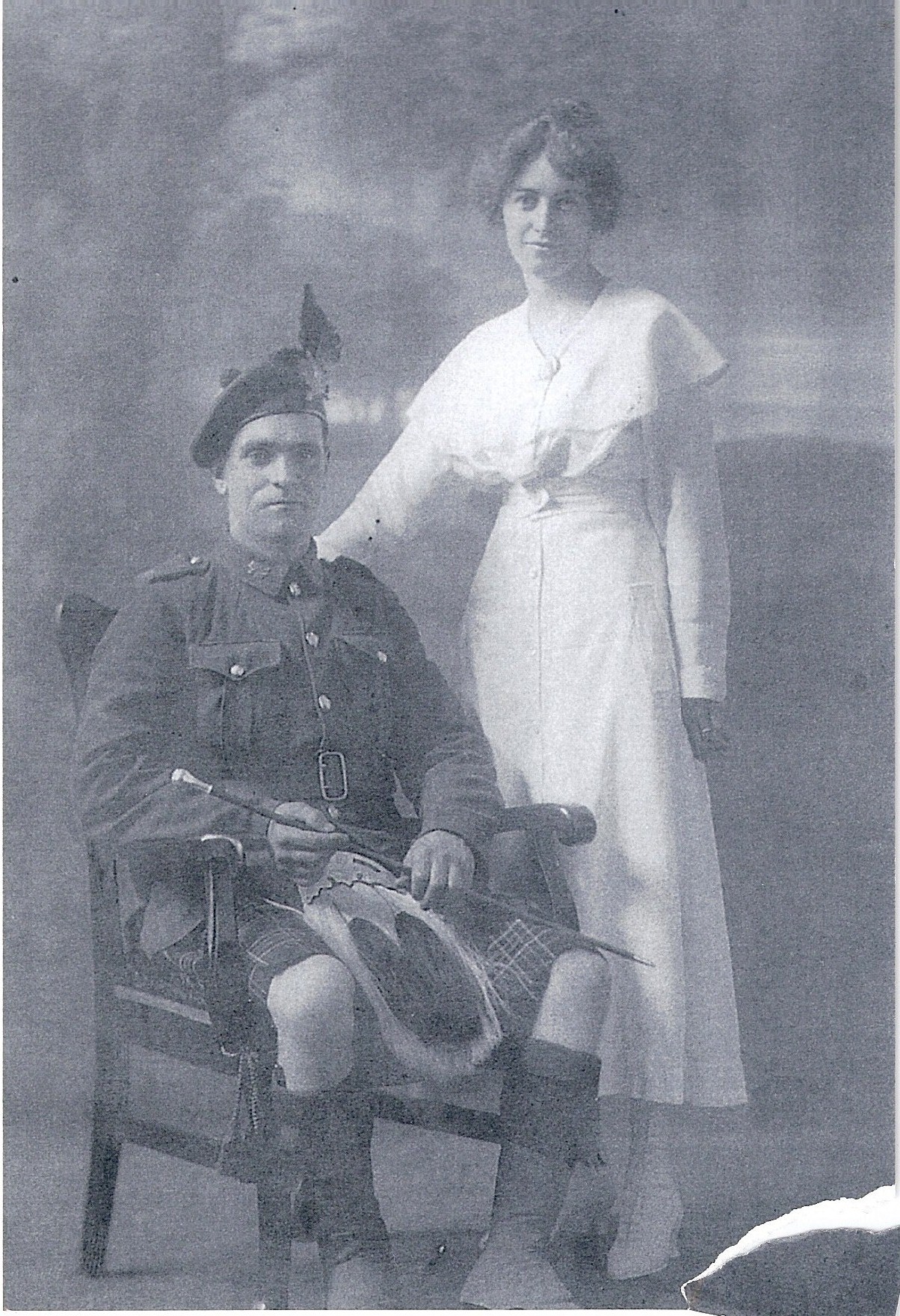
Clifford H W Jukes and Elizabeth Briggs 1917
Clifford died 43 days short of the Armistice and the end of the War. He was buried in the Mill Switch British Cemetary located at CambrTilloy-les-Cambrai, a village 2.5 kilometres north of Cambrai. Tilloy village was captured by the Canadian Corps at the end of September 1918, and the cemetery was made by the Corps Burial Officer in the following month. The name is due to a switch line from the Cambrai-Douai railway which ran in September 1918, to a large German supply dump on the site of the mill 800 metres North-West of the cemetery. There are now over 100, 1914-18 war casualties commemorated on this site.
Clifford Henry Wimbush Jukes was born on 8 April 1894 in Birmingham, England. He came to Canada shortly after his eighth birthday with his brother William LEONARD Jukes who was eleven years old at the time. (Leonard’s story can be found in an earlier post).
The two boys arrived at the port of Halifax on June 4, 1902, under the auspices of the Middlemore Homes.
James and Isabella Davidson of Stanley opened their home to the two boys. In the 1910 Census of Canada, the Davidson’s listed Clifford as their adopted son. Clifford and Leonard worked on the Davidson farm as this was one of the primary reasons that Canadian families took Middlemore children into their care. Clifford resided with Leonard and his wife Nancy in Douglas at the time of his marriage to Elizabeth (Lizzie) Briggs on 4 March 1917. When Clifford married Lizzie he had already signed up to go to war. His Attestation Papers indicate his occupation was cook, while his marriage certificate states his occupation as a soldier. Before he married Lizzie he lived with his brother Leonard and his family in Douglas, NB. Clifford’s daughter Doris Eliza Jukes was born 5 March 1918 in Fredericton and was just 5 months old at the time of his death.
It has been suggested by some researchers that many British Home Children signed up to serve in the Canadian Expeditionary Force as a way to return to their families in England. Clifford listed his mother and her address, who had remarried, as his next of kin in his Attestation Papers so we know he was in contact with her. We also know that he spent time with his family in England when he went overseas because he is pictured with his family in
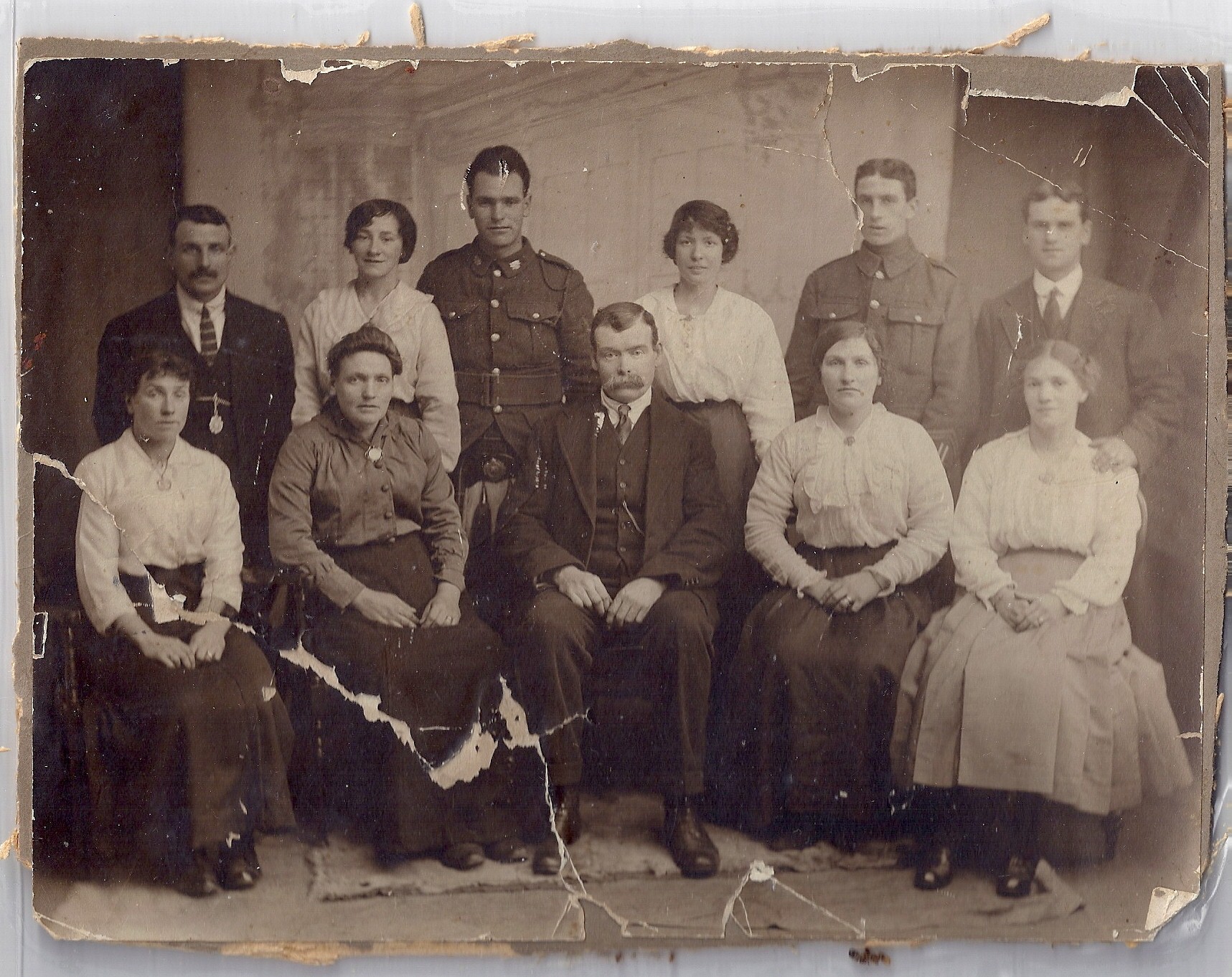
Jukes Family – 1918 England
Clifford is in back row between his two sisters.his Royal Highlander Uniform in this photo. I cannot help but think that perhaps all Clifford wanted was to see his mother again.
Primary Sources
War Diary of 42nd Battalion Quebec Regiment (Royal Highlanders of Canada), Historical Documents, Archives of Canada
Middleton Homes Records, Historical Documents, Archives of Canada
Secondary Sources
Provincial Archives of New Brunswick
Canadian War Graves Commission
 Tapestry